Bhutan
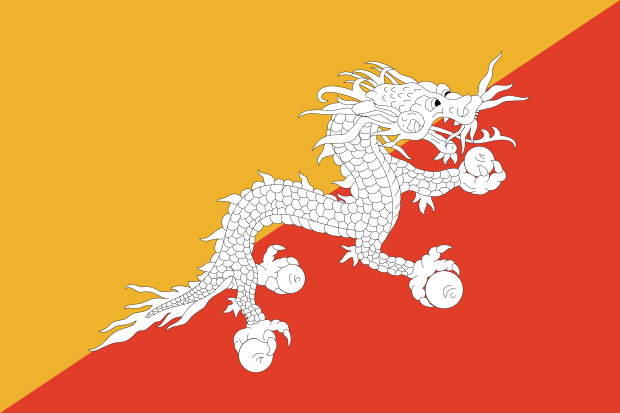
Country flag available in this resolutions
| Icon 32x21 |  |
| Icon 88x59 |  |
Bhutan
Bhutan, officially known as the Kingdom of Bhutan, is a landlocked country nestled in the Eastern Himalayas, a realm where ancient traditions harmoniously coexist with a carefully managed approach to modernization. Its distinctive culture, preserved by geography and deliberate policy, has earned it the moniker Land of the Thunder Dragon. This isolated nation, often shrouded in mist and mystery, offers a unique glimpse into a society that prioritizes Gross National Happiness over Gross Domestic Product. Understanding Bhutan requires an exploration of its diverse geography, rich history, evolving demographics, and its distinctive economic model, all of which contribute to its singular identity on the global stage.
Geographically, Bhutan is a land of dramatic contrasts. It is situated in South Asia, bordering China to the north and India to the south, east, and west. The countrys topography is characterized by its steep mountainous terrain, with altitudes ranging from a few hundred meters in the southern subtropical plains to over 7,000 meters in the northern Himalayan peaks. This rugged landscape has profoundly shaped Bhutans development, fostering a sense of isolation and self-reliance. The country is divided into three main geographical zones: the Duars Plain in the south, a narrow strip of fertile land; the Inner Himalayas in the center, characterized by lower mountain ranges and fertile valleys; and the Great Himalayas in the north, home to snow-capped peaks and glaciers. Major rivers, such as the Amo Chu, Wong Chu, and Manas Chu, originate in the Himalayas and flow southwards, providing vital water resources for agriculture and hydropower. The country’s forests cover a significant portion of its landmass, a testament to its strong environmental conservation policies. Bhutans commitment to environmental protection is enshrined in its constitution, which mandates that at least 60% of the country remain under forest cover. This dedication has led to a unique biodiversity, with a rich array of flora and fauna, including rare and endangered species. The countrys isolation, while presenting challenges, has also been instrumental in preserving its pristine natural environment and its unique cultural heritage.
The history of Bhutan is a tapestry woven with threads of spiritual devotion, political unification, and a long-standing tradition of isolation. The earliest inhabitants are believed to have settled in the region as early as 2000 BCE, but significant historical records begin with the arrival of Buddhism in the 7th century CE. The legendary Guru Rinpoche, also known as Padmasambhava, is credited with introducing Tantric Buddhism to Bhutan, and his influence remains deeply ingrained in the countrys spiritual and cultural fabric. The unification of Bhutan under a single political entity is largely attributed to Shabdrung Ngawang Namgyal, a Tibetan lama who fled to Bhutan in the 17th century. He established a dual system of government, with spiritual and temporal leaders, and built numerous dzongs (fortress-monasteries) that still serve as administrative and religious centers today. This period also saw the development of a distinct Bhutanese identity, separate from its Tibetan and Indian neighbors. For centuries, Bhutan maintained a policy of deliberate isolation, limiting foreign contact and trade to preserve its culture and sovereignty. This isolation, while protecting Bhutan from external influences, also meant that it lagged behind in terms of technological and economic development. The 20th century brought gradual changes, with the establishment of a hereditary monarchy in 1907, marking the beginning of the Wangchuck dynasty, which continues to reign today. The country began to open up cautiously to the outside world, initiating small-scale development projects and seeking international cooperation, all while striving to maintain its unique heritage and national identity.
The demographics of Bhutan present an interesting picture of a relatively small and ethnically diverse population that is undergoing gradual change. The total population of Bhutan is estimated to be around 770,000 people, making it one of the least populated countries in the world. The majority of the population consists of ethnic Bhutanese, who are broadly categorized into three main groups: the Sharchops, who are believed to be the earliest inhabitants; the Ngalops, who migrated from Tibet in the 9th century and are dominant in the western regions; and the Lhotshampas, who are of Nepalese origin and primarily inhabit the southern foothills. While the Ngalops and Sharchops are the dominant ethnic groups, the Lhotshampa community has faced challenges and periods of political tension. The official language is Dzongkha, spoken by the Ngalops, but various other languages and dialects are spoken by different ethnic groups. Buddhism, specifically Mahayana Buddhism, is the state religion and plays a central role in the lives of most Bhutanese. Hinduism is practiced by a significant portion of the Lhotshampa population. The population distribution is uneven, with a higher concentration in the fertile valleys of the western and central regions. Urbanization is a relatively recent phenomenon, with Thimphu, the capital, being the largest city and the primary center of economic and administrative activity. Bhutan has a relatively young population, with a significant proportion of its citizens under the age of 25. The country has made strides in improving its healthcare and education systems, leading to increased life expectancy and literacy rates. However, challenges remain in ensuring equitable access to these services across all regions and ethnic groups.
Bhutans economy is characterized by its unique approach, prioritizing sustainable development and the well-being of its citizens through the philosophy of Gross National Happiness (GNH). Historically, Bhutan’s economy was primarily agrarian, with a large portion of the population engaged in subsistence farming. While agriculture remains a significant sector, contributing to food security and rural livelihoods, the economy has diversified considerably over the past few decades. The government has strategically focused on developing sectors that align with its GNH philosophy and its natural endowments. Hydropower is a cornerstone of Bhutans economy, with its abundant water resources harnessed to generate electricity. A substantial portion of this electricity is exported to India, providing a crucial source of foreign exchange. Tourism is another vital sector, though it is managed under a strict high-value, low-impact policy. Visitors are required to pay a daily Sustainable Development Fee, which helps to fund social services and infrastructure development while ensuring that the countrys pristine environment and cultural heritage are preserved. This policy aims to attract responsible tourists who contribute positively to the Bhutanese economy and society. Other key sectors include forestry, small-scale manufacturing, and handicrafts. The government has also been investing in developing its information and communication technology (ICT) sector. Bhutans economic policies are guided by its GNH framework, which measures progress not just by economic indicators but also by factors such as environmental conservation, cultural preservation, good governance, and psychological well-being. This holistic approach aims to ensure that economic development is inclusive and sustainable, benefiting all segments of society and protecting the nations unique character. Despite its progress, Bhutan faces challenges such as its landlocked status, limited access to international markets, and a reliance on foreign aid for certain development projects. However, its commitment to its unique development model continues to shape its economic trajectory.
Information about country Bhutan
Automated text translation, excuse errors, please!
Informations are from the publication CIA The World Factbook.
Country Bhutan is situated in a location / continent South Asia. Bhutan has an area of 38 394 km2 and 716 896 residents. The highest point has a height 7 553 above sea level. and it is called Kula Kangri. The lowest point is located at the level of 97 above sea level and it is named Drangme Chhu. System of government is constitutional monarchy.The capital city is Thimphu. Bhutan has the international abbreviation BT.
Bhutan - economy
Total gross domestic product (GDP) is 4 342 000 000 $. Total gross domestic product per capita in purchasing power parity is 6 200 $. GDP grows by 5.90 % a year. Inflation (consumer price index) is equal to 7.70 % a year. Bhutan have 299 900 working-age population (from a total population 716 896 people). Unemployment is at 4.00 %. Bhutan issued 5.50 % GDP to healt care and 1,00 % GDP to army. The public debt of the country is 78.90 % GDP. The total amount of foreign debt is 1 275 000 000 USD.
Bhutan - transport and telecommunications
Bhutan has 8 050 km of roads and 2 airports.
Number of active mobile phones (sim card) in the country Bhutan is 484 200. Number of active fixed telephone lines is 27 500. Bhutan has 50 000 internet users, who have the available 14 714 Internet connections. Bhutan has been assigned a domain first Choose range .bt.
Bhutan - demography
As suggested above, Bhutan has 716 896 people. Population growth is in the amount 1.18 % per year. Number of children born per 1000 population per year is 18.75.Every mother has average 2.13 children. The infant mortality rate is 42.17 and maternal mortality 180.00 deaths per 100,000 births. Average estimated life expectancy makes 67.88 years. Mortality is 6.99 people per 1000 population per year.
Bhutan - energetics
Bhutan consumes a year 1 161 000 000 kWh of electricity. Annual electricity production is 6 826 000 000 kWh in power plants with a total installed electrical capacity 1 505 000 kW. Bhutan exports 5 500 000 000 kWh and imports 20 000 000 kWh of electricity per year Energy mix of power generation is as follows: fossil fuels: 1.1 %, nuclear energy: 0 %, renewable: 0.0 %, hydropower: 98.9 %.
Flags
World flags
World flags
Flags of the World countries
Dále doporučujeme:
Naše tipy na užitečné webyOdkazy na partnerské weby
Doporučené odkazy na zajímavé weby
Tipy na zajímavé weby
Zajímavé linky na nejrůznější weby
 |
 |
 |
 |
 |
 |
 |
 |
 |
 |
 |
 |
 |
 |
 |
 |
 |
 |
 |