Bosnia and Herzegovina
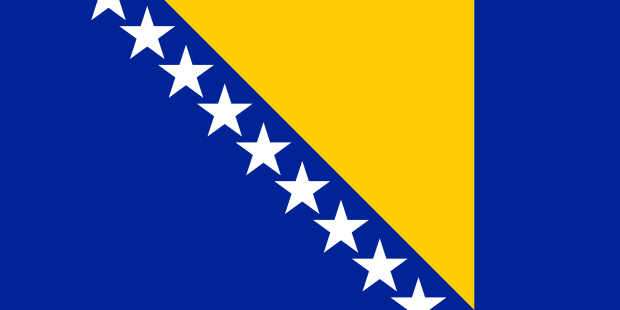
Country flag available in this resolutions
| Icon 32x16 |  |
| Icon 88x44 |  |
Bosnia and Herzegovina
Bosnia and Herzegovina: A Land of Crossroads and Resilience
Bosnia and Herzegovina, a nation nestled in the heart of the Balkan Peninsula, is a country defined by its intricate tapestry of cultures, its dramatic natural landscapes, and a history marked by both periods of remarkable prosperity and profound conflict. Its geographical position, straddling the divide between Eastern and Western Europe and historically a frontier between empires, has profoundly shaped its identity. From the rugged Dinaric Alps to the fertile river valleys, the country offers a diverse and often breathtaking scenery, a testament to the powerful forces of nature that have sculpted its terrain over millennia. This rich heritage, coupled with a complex sociopolitical landscape, makes Bosnia and Herzegovina a compelling subject of study and a destination that continues to intrigue and inspire.
The demographic makeup of Bosnia and Herzegovina is one of its most defining and, at times, most challenging characteristics. The country is home to three constitutionally recognized constituent peoples: Bosniaks, Serbs, and Croats, each with their distinct linguistic, religious, and cultural traditions. Bosniaks are predominantly Muslim, Serbs are predominantly Orthodox Christian, and Croats are predominantly Catholic. This religious and ethnic diversity has historically been a source of both vibrant cultural exchange and, tragically, deep-seated tensions. The Bosnian War (1992-1995) had a devastating impact on the countrys demographics, leading to widespread displacement, significant loss of life, and a substantial diaspora. While the war ended nearly three decades ago, its demographic consequences continue to resonate, with many of the countrys skilled workers and younger generations having sought opportunities abroad, leading to an aging population and concerns about brain drain. Despite these challenges, the spirit of coexistence, though tested, remains a vital element of the Bosnian identity, with communities striving to rebuild and foster understanding across ethnic and religious lines. The official languages are Bosnian, Croatian, and Serbian, which are largely mutually intelligible, reflecting the shared linguistic roots of the constituent peoples.
Economically, Bosnia and Herzegovina presents a complex picture of post-war recovery and ongoing transformation. The country’s economy, like its society, bears the scars of the recent conflict. Prior to the war, Bosnia and Herzegovina was a significant industrial powerhouse within the former Yugoslavia, with a strong focus on mining, metallurgy, and manufacturing. The war, however, decimated much of this infrastructure, leading to a sharp decline in production and a significant loss of employment. In the years following the Dayton Accords, which brought an end to the war, the country embarked on a path of economic reform and reconstruction. International aid and investment have played a crucial role in this process, helping to rebuild infrastructure, support small and medium-sized enterprises, and foster economic growth. However, challenges persist. Unemployment remains a significant issue, particularly among young people, and the economy is heavily reliant on remittances from Bosnians living abroad. The countrys industrial base is gradually recovering, with sectors such as agriculture, tourism, and information technology showing increasing potential. Bosnia and Herzegovina is also working towards closer integration with European Union markets, a process that involves aligning its economic policies and regulations with EU standards. The currency is the Bosnia and Herzegovina convertible mark (BAM), which is pegged to the euro. Despite the economic hurdles, there is a palpable sense of determination and entrepreneurial spirit driving the nation’s economic resurgence.
The geography of Bosnia and Herzegovina is as varied as its cultural heritage. The country is characterized by a rugged mountainous terrain, with the Dinaric Alps dominating much of its landscape. These mountains are interspersed with fertile river valleys, most notably the Sava River valley to the north, which forms a significant agricultural region. The country boasts a short but picturesque coastline on the Adriatic Sea, centered around the town of Neum, which serves as Bosnia and Herzegovinas sole access to the sea. This coastal strip, though narrow, offers stunning views and potential for tourism. Inland, numerous rivers crisscross the nation, including the Bosna, Vrbas, and Neretva, many of which are renowned for their pristine beauty and offer opportunities for adventure tourism such as rafting and kayaking. The countrys natural beauty extends to its numerous national parks, such as Sutjeska National Park, home to the highest peak in Bosnia and Herzegovina, Maglić, and the ancient Perucica rainforest, one of the last remaining primeval forests in Europe. The climate varies across the country, with continental influences in the north and a more Mediterranean climate along the coast. This diverse geography has not only shaped the countrys historical development, influencing trade routes and settlement patterns, but also provides a rich natural resource base and significant potential for ecotourism.
The history of Bosnia and Herzegovina is a long and complex narrative, deeply intertwined with the ebb and flow of empires and the struggles for identity. For centuries, the region was a crossroads of civilizations, influenced by Roman, Byzantine, and Ottoman rule. Under Ottoman dominion, which lasted for over four centuries, Islam became a prominent religion, and many of the regions inhabitants converted, contributing to the unique cultural synthesis that defines Bosnia today. The Ottomans also left an indelible mark on the architecture, cuisine, and customs of the land. In the late 19th century, the Austro-Hungarian Empire annexed Bosnia and Herzegovina, ushering in a new era of modernization and administrative reforms, but also fueling nationalist sentiments among various ethnic groups. The assassination of Archduke Franz Ferdinand in Sarajevo in 1914, an event that triggered World War I, highlighted the volatile political climate of the region. Following World War I, Bosnia and Herzegovina became part of the Kingdom of Yugoslavia, and after World War II, it was one of the six federal republics of socialist Yugoslavia, led by Josip Broz Tito. This period, while marked by relative peace and economic development, also suppressed overt expressions of national identity. The dissolution of Yugoslavia in the early 1990s led to a devastating war, as Bosnia and Herzegovina declared independence and faced a brutal conflict fueled by ethnic tensions and territorial disputes. The Dayton Peace Agreement in 1995 ended the war but established a complex political structure that continues to shape the countrys governance. Today, Bosnia and Herzegovina is a sovereign state, working to overcome its past and build a unified future, a testament to the resilience of its people and the enduring spirit of a land that has witnessed so much history.
Information about country Bosnia and Herzegovina
Automated text translation, excuse errors, please!
Informations are from the publication CIA The World Factbook.
Country Bosnia and Herzegovina is situated in a location / continent Europe. Bosnia and Herzegovina has an area of 51 197 km2 and 3 879 296 residents. The highest point has a height 2 386 above sea level. and it is called Maglic. The lowest point is located at the level of 0 above sea level and it is named Adriatic Sea. System of government is Federal Republic and the date of independence First March 1992. The capital city is Sarajevo. Bosnia and Herzegovina has the international abbreviation BK.
Bosnia and Herzegovina - economy
Total gross domestic product (GDP) is 32 040 000 000 $. Total gross domestic product per capita in purchasing power parity is 8 200 $. GDP grows by 1.70 % a year. Inflation (consumer price index) is equal to 3.70 % a year. Bosnia and Herzegovina have 2 600 000 working-age population (from a total population 3 879 296 people). Unemployment is at 43.30 %. Bosnia and Herzegovina issued 10.90 % GDP to healt care .The public debt of the country is 43.30 % GDP. The total amount of foreign debt is 10 540 000 000 USD.
Bosnia and Herzegovina - transport and telecommunications
Bosnia and Herzegovina has 22 926 km of roads, 601 km of railway lines and 25 airports.
Number of active mobile phones (sim card) in the country Bosnia and Herzegovina is 3 171 000. Number of active fixed telephone lines is 955 900. Bosnia and Herzegovina has 1 422 000 internet users, who have the available 146 152 Internet connections. Bosnia and Herzegovina has been assigned a domain first Choose range .ba.
Bosnia and Herzegovina - demography
As suggested above, Bosnia and Herzegovina has 3 879 296 people. Population growth is in the amount -0.00 % per year. Number of children born per 1000 population per year is 8.89.Every mother has average 1.24 children. The infant mortality rate is 8.47 and maternal mortality 8.00 deaths per 100,000 births. Average estimated life expectancy makes 78.96 years. Mortality is 8.91 people per 1000 population per year.
Bosnia and Herzegovina - energetics
Bosnia and Herzegovina consumes a year 10 170 000 000 kWh of electricity. Annual electricity production is 15 040 000 000 kWh in power plants with a total installed electrical capacity 4 341 000 kW. Bosnia and Herzegovina exports 5 877 000 000 kWh and imports 2 887 000 000 kWh of electricity per year Energy mix of power generation is as follows: fossil fuels: 44.5 %, nuclear energy: 0 %, renewable: 0.0 %, hydropower: 55.5 %.
Flags
World flags
World flags
Flags of the World countries
Dále doporučujeme:
Odkazy na partnerské webyOdkazy na zajímavé weby
Doporučené odkazy na zajímavé weby
Tipy na Partnerské weby
Zajímavé linky na nejrůznější weby
 |
 |
 |
 |
 |
 |
 |
 |
 |
 |
 |
 |
 |
 |
 |
 |
 |
 |
 |