Burundi

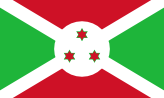
Country flag available in this resolutions
| Icon 32x19 |  |
| Icon 88x53 |  |
Burundi
Burundi: A Land of Lakes, Mountains, and Enduring Resilience
Burundi, officially the Republic of Burundi, is a landlocked nation situated in the heart of East Africa, a region often referred to as the Great Lakes Region. Its geographical location, nestled between Rwanda to the north, Tanzania to the east and south, and the Democratic Republic of Congo to the west, profoundly shapes its climate, biodiversity, and historical interactions. The country is dominated by a central plateau that slopes gently towards the eastern plains and rises dramatically in the west, forming the formidable Congo-Nile Divide. This impressive mountain range, a significant watershed, contributes to the countrys abundant water resources. The western part of Burundi is characterized by steep valleys and the majestic Lake Tanganyika, the second-deepest lake in the world and the longest freshwater lake on the planet. Lake Tanganyika is not merely a geographical feature; it is a vital artery for the nation, supporting fishing industries, transportation, and providing a stunning natural backdrop to the countrys western regions. The climate of Burundi is largely tropical, moderated by its high altitude. The highlands experience cooler temperatures and significant rainfall, supporting lush vegetation and agriculture, while the eastern lowlands are hotter and drier. This diverse topography and climate foster a rich tapestry of ecosystems, from verdant montane forests to savannas, though significant deforestation has impacted many of these areas due to agricultural expansion and fuel wood consumption. The country’s natural beauty, often overlooked amidst its complex socio-political landscape, offers immense potential for tourism, a sector that remains largely underdeveloped but holds promise for future economic diversification.
The demographic profile of Burundi is marked by a young and rapidly growing population, a characteristic shared with many sub-Saharan African nations. The latest estimates place the population at well over 12 million people, with a median age that is remarkably low, indicating a high dependency ratio and significant future demands on resources and employment. The ethnic composition of Burundi is historically dominated by three main groups: the Hutu, the Tutsi, and the Twa. For decades, the relationship between these groups has been a central, and often tragic, theme in the countrys history, marked by periods of intense conflict and violence. While the distinctions between these groups are often blurred by intermarriage and shared cultural practices, historical power dynamics and political manipulation have frequently exacerbated ethnic tensions. The official languages are Kirundi and French, with Swahili also spoken in some commercial areas. The majority of the population practices Christianity, primarily Catholicism, though traditional animist beliefs and Islam also have a presence. Urbanization is a growing trend, with the capital city, Bujumbura, serving as the primary economic and administrative hub. However, the vast majority of Burundians still reside in rural areas, engaged in subsistence agriculture. The rapid population growth, coupled with limited economic opportunities, places considerable strain on infrastructure, social services, and the environment, creating a perpetual cycle of challenges that the nation continuously strives to overcome.
The economy of Burundi is predominantly agrarian, with a heavy reliance on subsistence farming and the export of a few key cash crops. Coffee and tea have historically been the backbone of Burundi’s export earnings, providing essential foreign exchange. However, global price fluctuations and challenges in production due to climate change, soil degradation, and political instability have made these sectors vulnerable. Agriculture employs the vast majority of the workforce, but productivity is often low due to traditional farming methods, limited access to modern technology, and small landholdings, exacerbated by population pressure. Beyond coffee and tea, other significant agricultural products include beans, cassava, maize, and bananas, primarily for domestic consumption. The industrial sector is underdeveloped, largely consisting of small-scale processing of agricultural products, light manufacturing, and artisanal activities. The service sector, particularly in Bujumbura, is growing but remains limited in scope. Burundi faces significant economic challenges, including high levels of poverty, a substantial national debt, and a chronic dependence on foreign aid. The country’s landlocked status further complicates trade and increases transportation costs. Despite these hurdles, the government has made efforts to attract foreign investment, improve the business environment, and diversify the economy, with a focus on sectors like tourism, mining, and information technology, though progress has been slow and often hampered by internal political and security issues.
The history of Burundi is a complex tapestry woven with threads of indigenous kingdoms, colonial rule, and post-independence struggles for power and stability. The Kingdom of Burundi, with a lineage of monarchs dating back centuries, was a significant political entity in the region before European colonization. The dominant narrative within this kingdom often involved the Hutu and Tutsi groups, with the Tutsi often holding positions of power, a dynamic that would have profound implications in the modern era. The late 19th century saw Burundi, along with neighboring Rwanda, fall under German East Africa, and after World War I, it became a Belgian League of Nations mandate territory. Belgian colonial rule, while bringing some administrative structures, often reinforced existing ethnic divisions, laying the groundwork for future conflicts. Independence was achieved in 1962, but the euphoria was short-lived. The post-independence period has been tragically marked by cycles of ethnic violence, coups détat, and civil war. The Hutu Revolution of 1972, followed by periods of Tutsi dominance and retaliatory violence, created deep societal scars. The signing of the Arusha Accords in 2000, brokered by Nelson Mandela, offered a roadmap for peace and power-sharing, leading to the election of the first Hutu president, Domitien Ndayizeye, in 2003. However, the path to lasting peace and reconciliation has been fraught with difficulties. A disputed election in 2015 triggered renewed political crisis and widespread violence, leading to a significant refugee outflow and international concern. Despite these persistent challenges, the Burundian people have demonstrated remarkable resilience, striving for peace, development, and a more inclusive future. The nation continues to navigate its complex past while seeking to forge a stable and prosperous tomorrow.
Information about country Burundi
Automated text translation, excuse errors, please!
Informations are from the publication CIA The World Factbook.
Country Burundi is situated in a location / continent Africa. Burundi has an area of 27 830 km2 and 10 557 259 residents. The highest point has a height 2 670 above sea level. and it is called Heha. The lowest point is located at the level of 772 above sea level and it is named Lake Tanganyika. System of government is republic and the date of independence July 1, 1962. The capital city is Bujumbura. Burundi has the international abbreviation BY.
Burundi - economy
Total gross domestic product (GDP) is 5 250 000 000 $. Total gross domestic product per capita in purchasing power parity is 600 $. GDP grows by 4.20 % a year. Inflation (consumer price index) is equal to 9.70 % a year. Burundi have 4 245 000 working-age population (from a total population 10 557 259 people). Burundi issued 13.10 % GDP to healt care and 5,90 % GDP to army. The public debt of the country is 78.40 % GDP. The total amount of foreign debt is 573 400 000 USD.
Burundi - transport and telecommunications
Burundi has 12 322 km of roads and 7 airports.
Number of active mobile phones (sim card) in the country Burundi is 1 980 000. Number of active fixed telephone lines is 32 600. Burundi has 157 800 internet users, who have the available 236 Internet connections. Burundi has been assigned a domain first Choose range .bi.
Burundi - demography
As suggested above, Burundi has 10 557 259 people. Population growth is in the amount 3.10 % per year. Number of children born per 1000 population per year is 40.58.Every mother has average 6.08 children. The infant mortality rate is 60.32 and maternal mortality 800.00 deaths per 100,000 births. Average estimated life expectancy makes 59.24 years. Mortality is 9.36 people per 1000 population per year.
Burundi - energetics
Burundi consumes a year 198 100 000 kWh of electricity. Annual electricity production is 127 000 000 kWh in power plants with a total installed electrical capacity 52 000 kW. Burundi exports 0 kWh and imports 80 000 000 kWh of electricity per year Energy mix of power generation is as follows: fossil fuels: 1.9 %, nuclear energy: 0 %, renewable: 0.0 %, hydropower: 98.1 %.
Flags
World flags
World flags
Flags of the World countries
Dále doporučujeme:
Tipy na užitečné webyDoporučené odkazy
Odkazy na užitečné webové stránky
Linky na partnerské weby
Partnerské internetové stránky
 |
 |
 |
 |
 |
 |
 |
 |
 |
 |
 |
 |
 |
 |
 |
 |
 |
 |
 |